What this document is
What follows is the result of two weeks of deep research into two separate questions. The first: what are people actually typing into Google when they go looking for help in this market? The second: what happens on YouTube to businesses that chase that same market without understanding how the platform really works?
The answer to the second question is unforgiving. YouTube has quietly buried every business that walked in with a good-on-paper SEO strategy and assumed the audience would follow. The platform taught us — clearly and at length — exactly which strategies others have tried in this niche and exactly how each one failed.
It also showed us something more useful: where the people we actually want to reach are gathering, what they're watching, and what they're starving for. Once you can see that, the question stops being “what should we make?” and starts being “which video, made first, draws them to us?”
So this document is two things at once. It's a record of what does not work in this market — and it's the only path I can find that does. It's organized as a story, not a list of findings. The conclusions build on each other, so it'll read best in order.
- A clear picture of what the SEO research told us.
- A clear picture of what the YouTube research revealed about how that SEO research would actually play out if we used it directly.
- Four specific video ideas to make first, each tied to real evidence and to one of the three core problems Brass Tacks solves.
- A clear list of what we're deliberately not going to do.
James pulled 16 keyword trunks from SEMrush. I consolidated them down and held every cluster up against a simple test: does this topic solve one of the three problems our ideal client actually has? Anything that didn't meet that bar I set aside — not deleted, just parked. What's left is 15 real homeowner-facing topic clusters. The full cluster-by-cluster breakdown, with search volumes and recommended blog/video titles, is in Appendix E.
The results split right down the middle & into two questions.
Nearly every high-volume keyword in the data is some version of one of these. Everything else stacks underneath one of the two columns.
- Contractors & general contractors
- Architects (cost, hiring, credentials)
- Contract review, AIA contracts, red flags
- Vetting big-brand builders (DR Horton, KB, Toll Brothers)
- ADUs — definitions, rules, permits
- Home additions
- Fire rebuilds & recovery
- California ADU grant
What jumped out — the standout findings.
People in California are still figuring out what an ADU even is. Saturated on YouTube already, but unavoidable.
People want a real number before they pick up the phone. Definitive pricing content is one of the highest-value things this channel could make.
Homeowners about to spend $400K+ are asking strangers on the internet whether the builder is any good. A custom LA builder has a real opening to speak directly to that doubt.
High volume, high empathy, directly downstream of the Eaton and Palisades fires. The biggest unprompted finding in the dataset.
Small individual volume, but extremely high intent — these are people about to sign something.
Had we acted on the SEO research alone, we would have absolutely and utterly failed.
The keyword data is overwhelmingly clear about who this audience is and what they're searching for. Every instinct says lead with it.
But the SEO data can't see what's already happening on YouTube to the businesses chasing this same audience with this same logic.
And that's exactly what we're about to see.
Subscriber and view counts below are a snapshot from our May 2026 research, kept as recorded rather than auto-updated - the screenshots are the record.
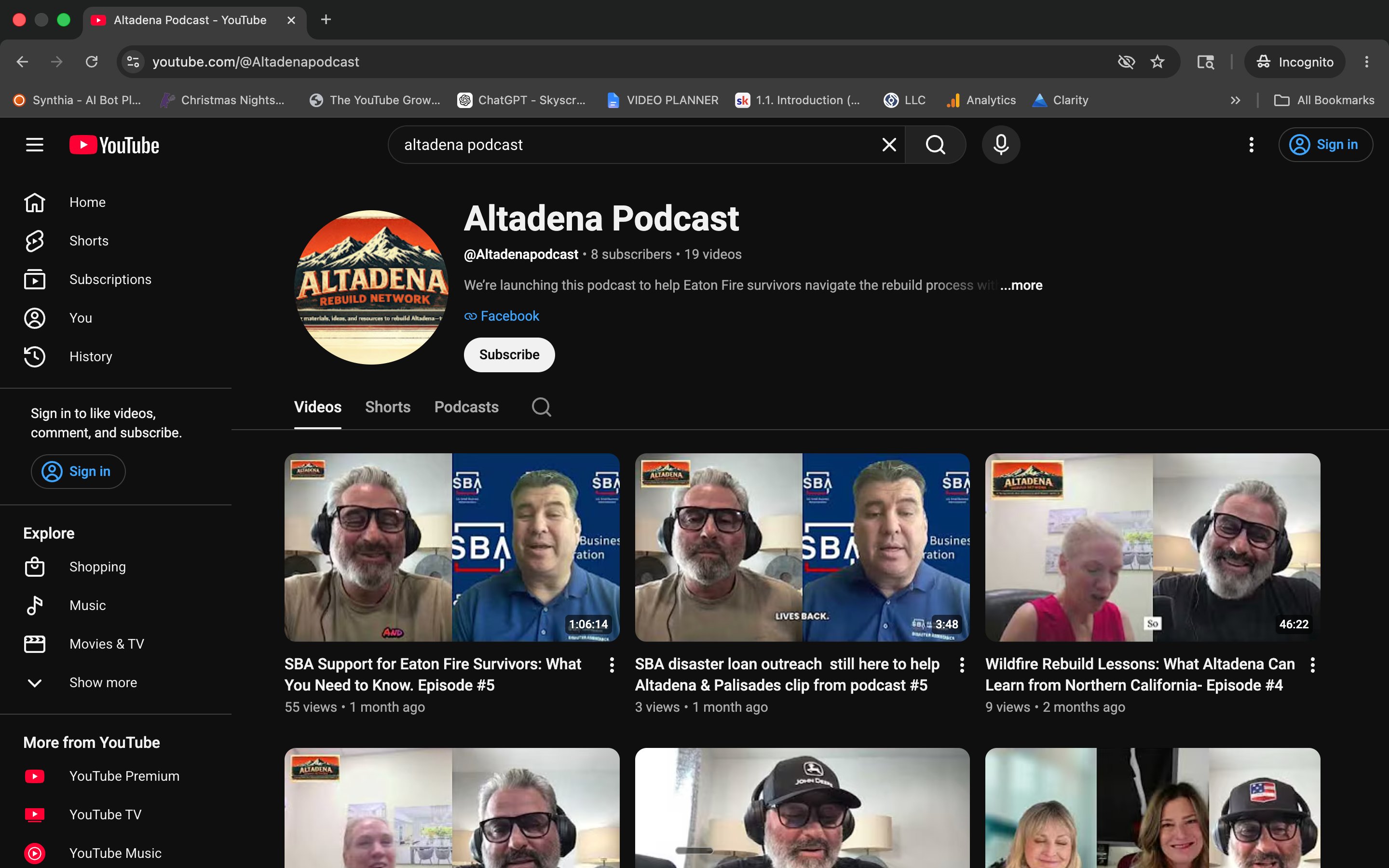
Example 1: Altadena Podcast
Decent production. Branded. Regular cadence. The exact audience we'd have been chasing — aimed at directly, and not landing.
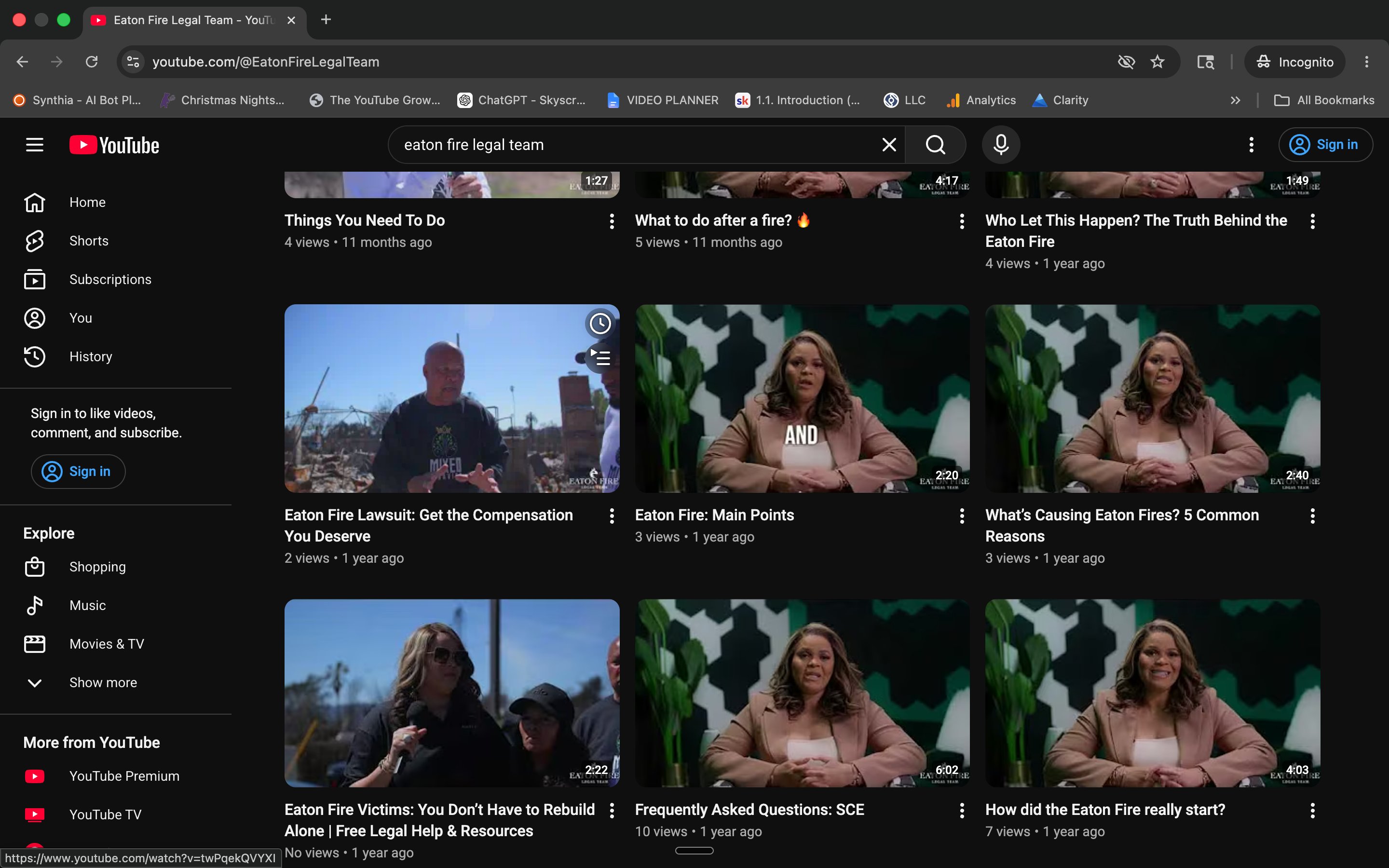
Example 2: Eaton Fire Legal Team
Two hundred and seventy-four videos. High volume, decent production, and the channel sits at 25 subscribers with most rebuild content getting single-digit views. Volume without strategy doesn't move the needle.
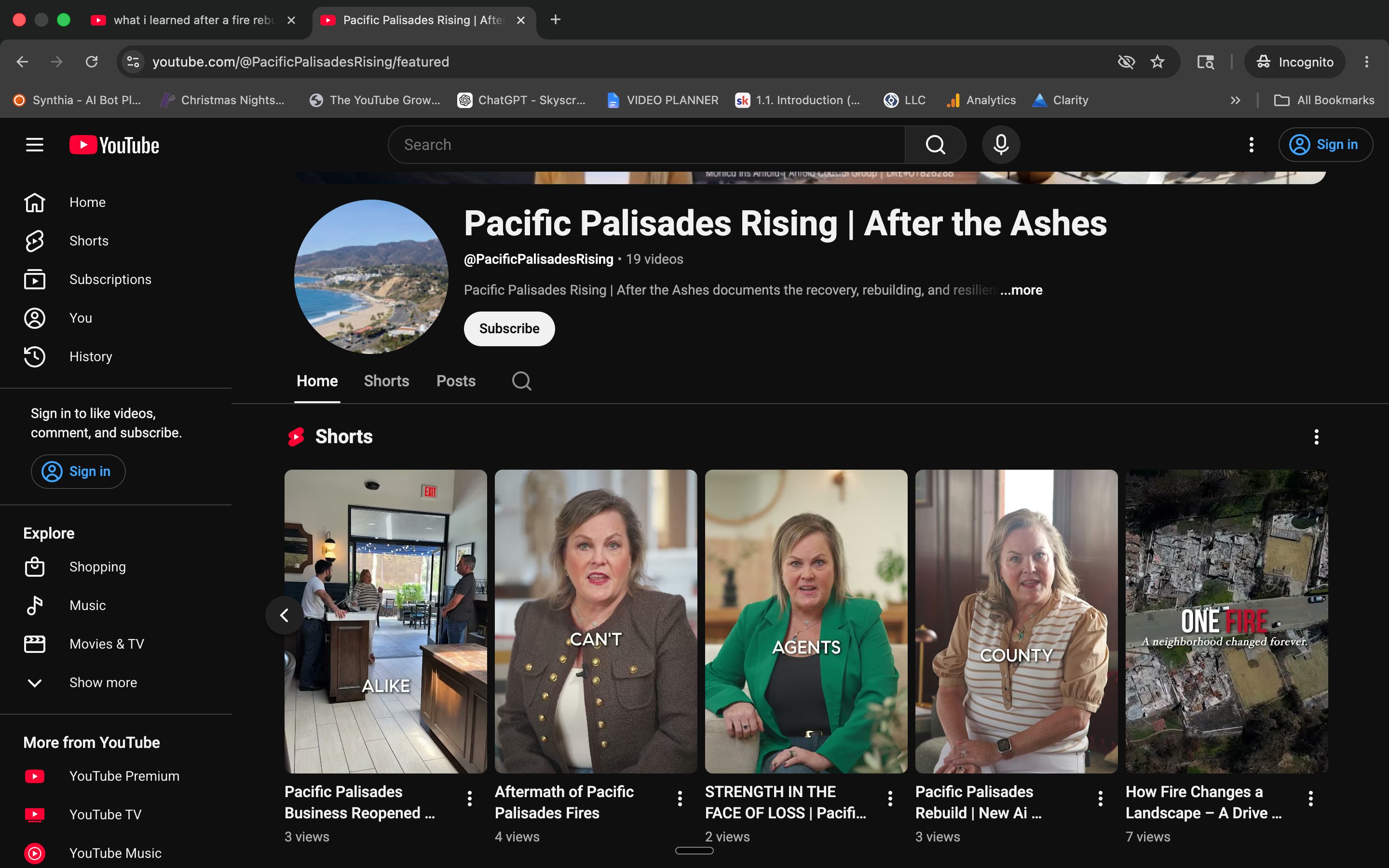
Example 3: Pacific Palisades Rising — "After the Ashes"
The channel banner is the agent's name and DRE license number. Shorts feature agents and other professionals talking about how they helped their clients through the disaster. The pitch is implied but unmistakable.
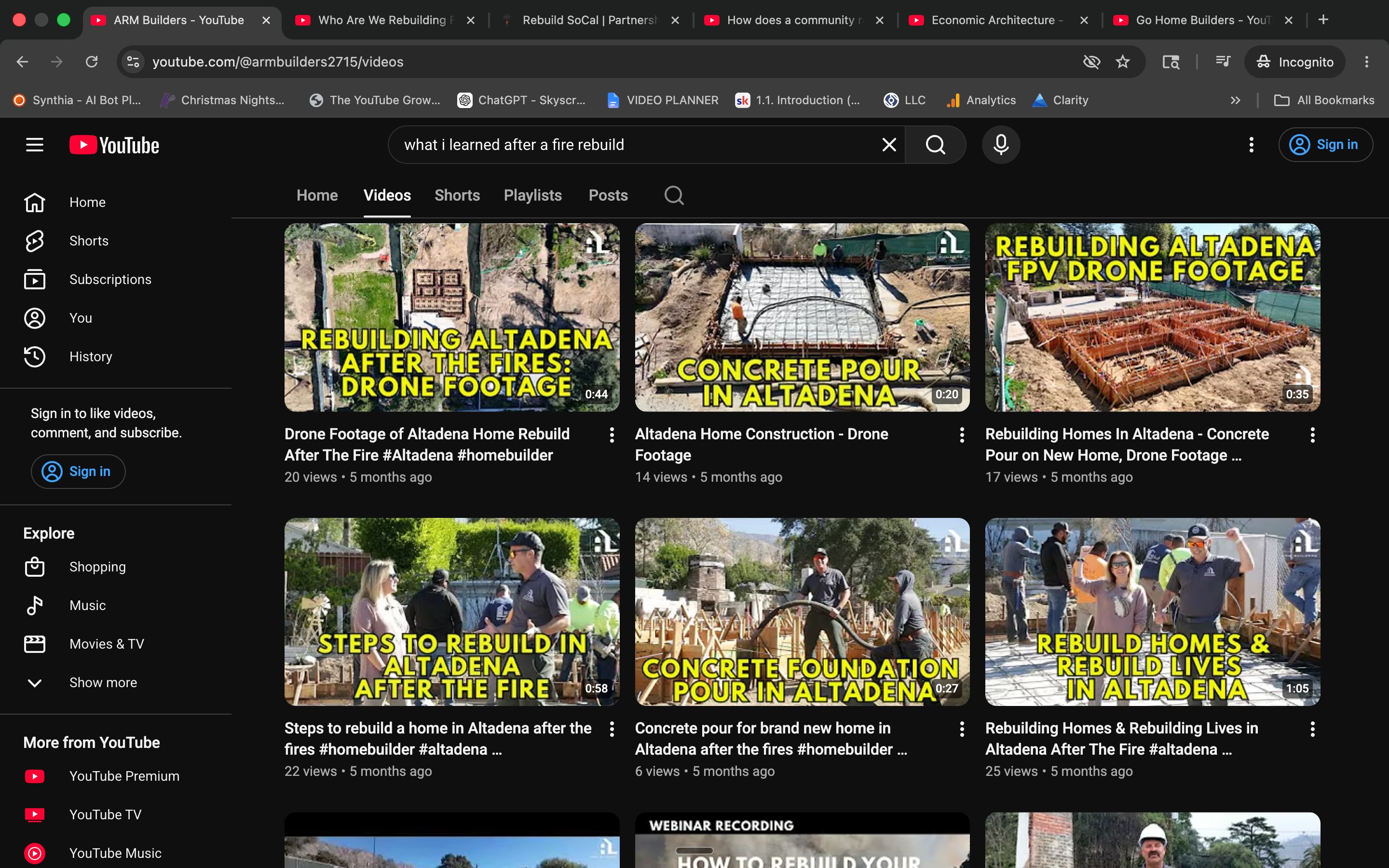
Example 4: ARM Builders.
Direct SEO-anchored titles: "Drone Footage of Altadena Home Rebuild After The Fire," "Steps to rebuild a home in Altadena after the fires," "Concrete Pour in Altadena." They built exactly the channel an SEO consultant would have built for anyone in this market. View counts still sat at 15 per video.
That's the mistake everyone else makes. SEO doesn't translate well onto YouTube. And Brass Tacks videos would have been buried right alongside everyone else's.
Not because the topics are wrong. But the positioning was.
The biggest insight — and it isn't about the fires.
My read is that YouTube is hyper-vigilant about businesses chasing survivors in the wake of a disaster. And it would be naive to assume this dynamic is unique to the Eaton fire. Every major earthquake, hurricane, wildfire, and tragedy brings businesses rushing in — some genuinely there to help, some less so. Drawing that line in real time, at scale, across thousands of channels, isn't a problem YouTube is positioned to solve.
So the platform appears to take a blunter route. When a channel reads as a business positioning itself in front of an affected audience, it gets quietly throttled — whether the operator is a podcaster, an attorney, a real estate agent, or a residential builder. Intent doesn't enter into it.
And that points to something more fundamental. YouTube does not want to be used as a marketing agency. That's the biggest single takeaway from this section — but we already knew that. This was just all proof.
So then — how do we make videos?
These aren't just videos I'm recommending we make. What I'm showing you is how YouTube actually works — and where the survivors of the Eaton fire are quietly gathering on the platform. And how that happens isn't what you'd think.
Sample #1 — a flop on views. A goldmine on who showed up.
By the channel's standards, this video flopped — a tenth of its normal performance. By ours, it's one of the cleanest signals in the entire dataset.
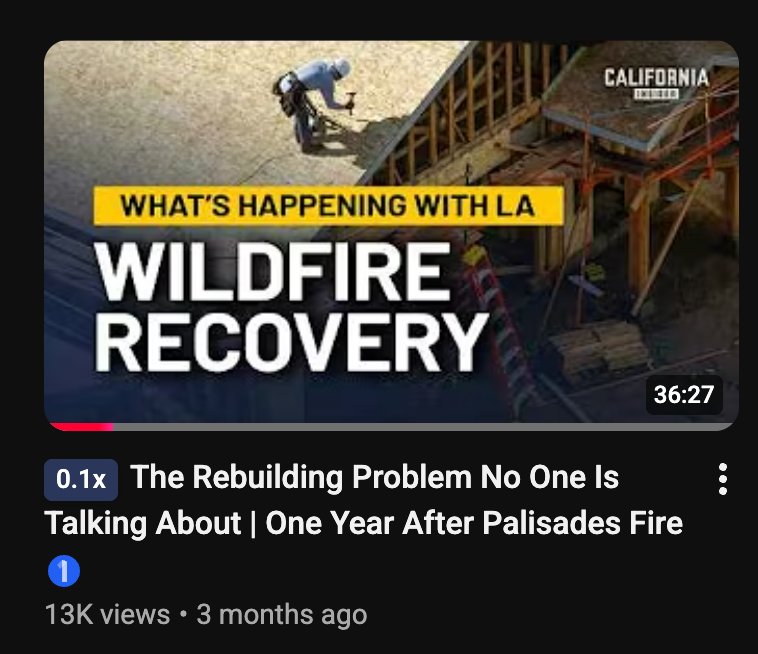
Then we ran the transcript and the entire comment section through our AI tools, and the picture changed completely. This video pulled a disproportionate number of viewers who were directly impacted by the fire. Fire survivors. Family members of fire survivors. Contractors who were working the rebuild, or trying to. On a video that drew a tenth of the channel's usual traffic, we found one of the densest concentrations of our exact target audience anywhere on YouTube.
Translation: this is a watering hole. These are the videos the affected community is quietly gathering at. Once we understand how to build a watering hole of our own, YouTube starts sending those same viewers directly to our content.
This is something I brought up at our first meeting, and this video is the cleanest proof of it: high view counts can actually hurt a channel when the views come from the wrong audience. What we want isn't the biggest crowd. It's the right crowd.
That said, some of the videos we make will be designed to go wider on purpose. Those big-net videos won't have the highest conversion rate — but inside that bigger crowd, we always catch new viewers who turn out to be ideal clients. Both kinds of videos matter: the high-fit watering-hole content, and the wider-reach content that pulls the right people in from a much bigger crowd.
A video like — "The Rebuilding Problem No One Is Talking About"
More detail on the underlying audience analysis is in Appendix A.
A "short process" video or a "deep dive." But we pick one specific cost or process dispute in the rebuild. For example, the hidden LADWP fees most homeowners don't budget for — and we walk through it with named numbers, named permits, named code requirements.Or we could go at the BIG conflict the comments surfaced: contractors vs. the people. Not that they're actually at odds — but that's how it's perceived. And given that you're effectively the middle man in this whole thing, you could literally play that role on camera. Stand between the two sides and translate.
Sample #2 — another unexpected watering hole.
A four-minute news segment about a Palisades fire survivor whose prefab home from Cover (an LA modular builder) was assembled on her lot. Walks through the factory, the founder, the production line, the finished home. No politics, no villain, no accountability fight. Just: here is one specific path through this, and here's what it looks like.
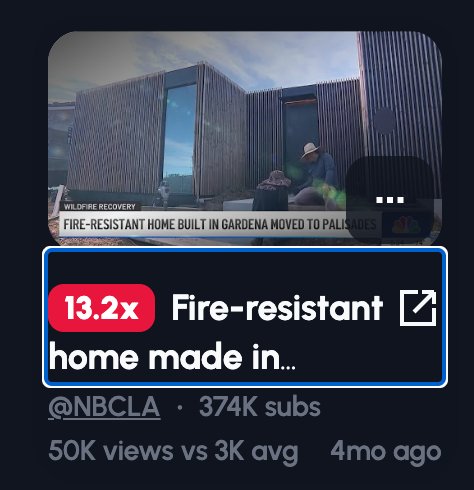
Once again, when the AI tools swept the comment section, the same pattern jumped out: a disproportionate, overwhelming number of fire survivors talking to each other in the thread. Different channel, different topic, same audience showing up at the watering hole.
What this tells us is important, and worth saying plainly. YouTube already knows exactly who these survivors are. The platform is currently recommending videos like this one directly to the affected community — meaning the distribution we need is already running, just on someone else's content.
So the takeaway from Sample #2 is the same as Sample #1, but stronger: if we intentionally build content designed to serve this community — and we pick topics they actually want answers to — YouTube is engineered to put it in front of them. This isn't about chasing keywords. It's about building the watering hole. The people will come.
A video like — "Fire-resistant home made in Gardena, moved to Palisades"
And then you explain why. Not as an attack on prefab as a category — but as people who love Altadena, know what the majority of residents actually want there, and can speak honestly about which of these solutions fit the neighborhood and which would erase what makes it Altadena. That position is yours to take, and almost nobody else on YouTube can take it credibly.
Sample #3 — a different kind of watering hole.
Samples #1 and #2 above pull a specific kind of audience: fire-affected residents looking for help with what just happened. Sample #3 is a watering hole too — just for a different audience and a different goal. Other channels in this space (the Altadena podcaster, the Eaton Fire legal team) have one singular goal: gather Altadena residents, full stop. Brass Tacks's goal is different and bigger — help people get through the rebuild process. That goal lives upstream of "just Altadena residents." It includes anyone evaluating a builder, anyone trying to read a bid, anyone Googling "how much does this actually cost." That's a much larger pool, and it's where Sample #3 fishes.
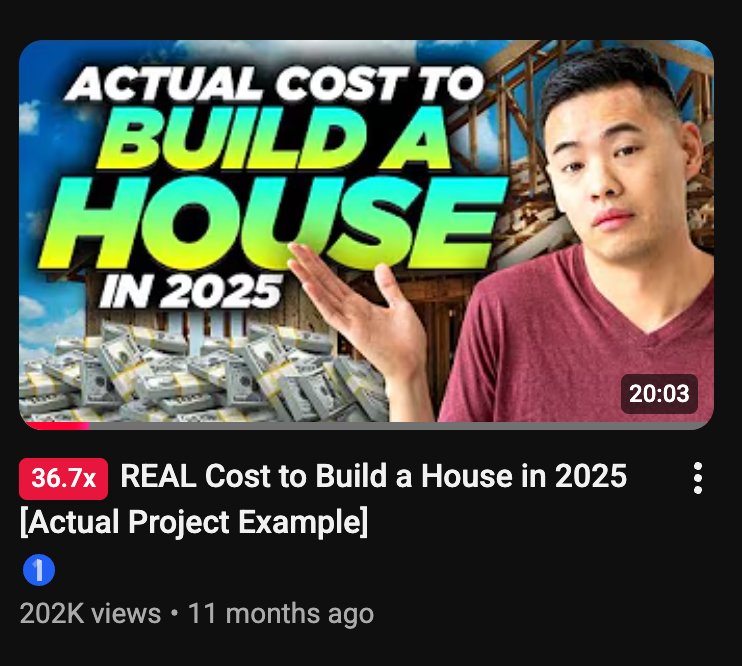
So this isn't a "let's drop the watering-hole strategy" move — it's an additional watering hole, pointed at the rebuild-process audience, and a key ingredient of the overall YouTube strategy. What we're testing here is the hypothesis that thumbnails and YouTube titles like the one below pull the right people in — people in the middle of evaluating real cost, real process, real contractor decisions.
One more thing worth knowing about the source video: @adrielhsu isn't a builder. He describes his channel as covering "everything related to real estate, travel, and personal finances." That's a relevant detail. The person who pulled 36.7× his baseline with a "REAL Cost to Build a House" video isn't competing against contractors — he's adjacent to them. Which means there's room for an actual LA custom builder to enter this lane with credibility nobody else in the lane has.
A 36.7× outlier on a small construction-education channel. The "real cost" angle is broadly searched and broadly watched — and it's the exact lane Brass Tacks already lives in every working day.
Supporting evidence — this pattern works across multiple smaller channels too:
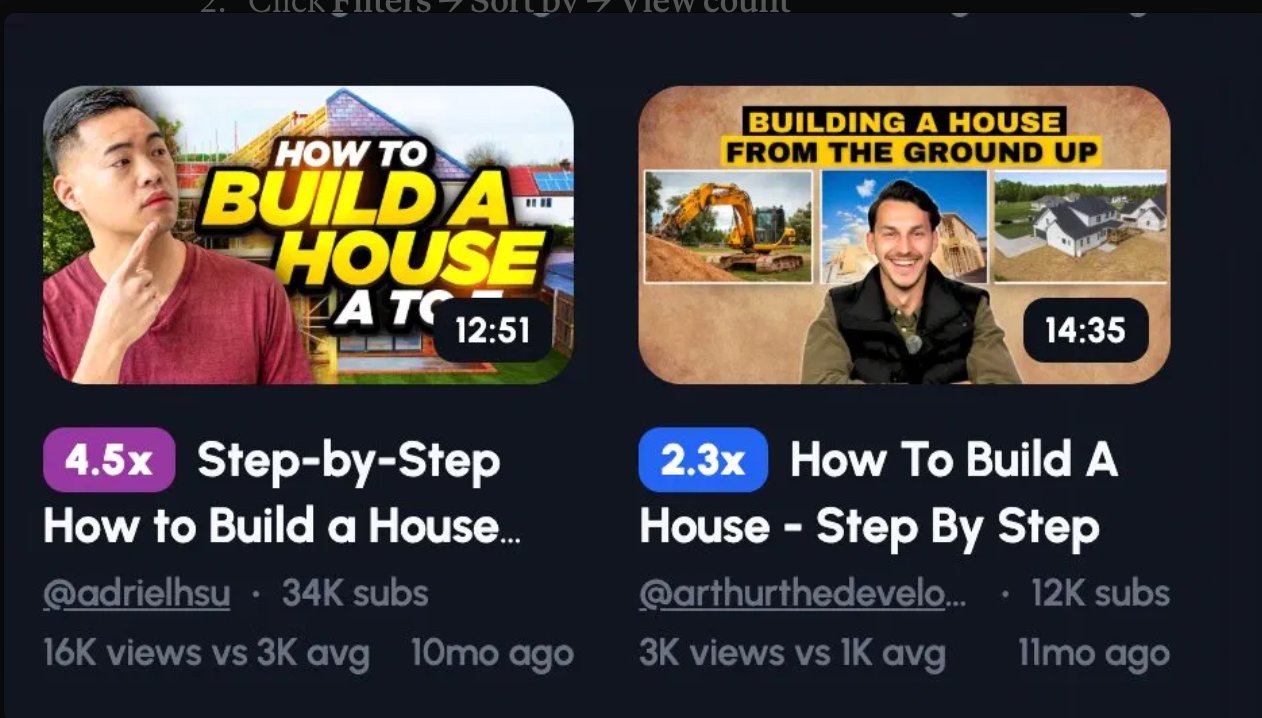
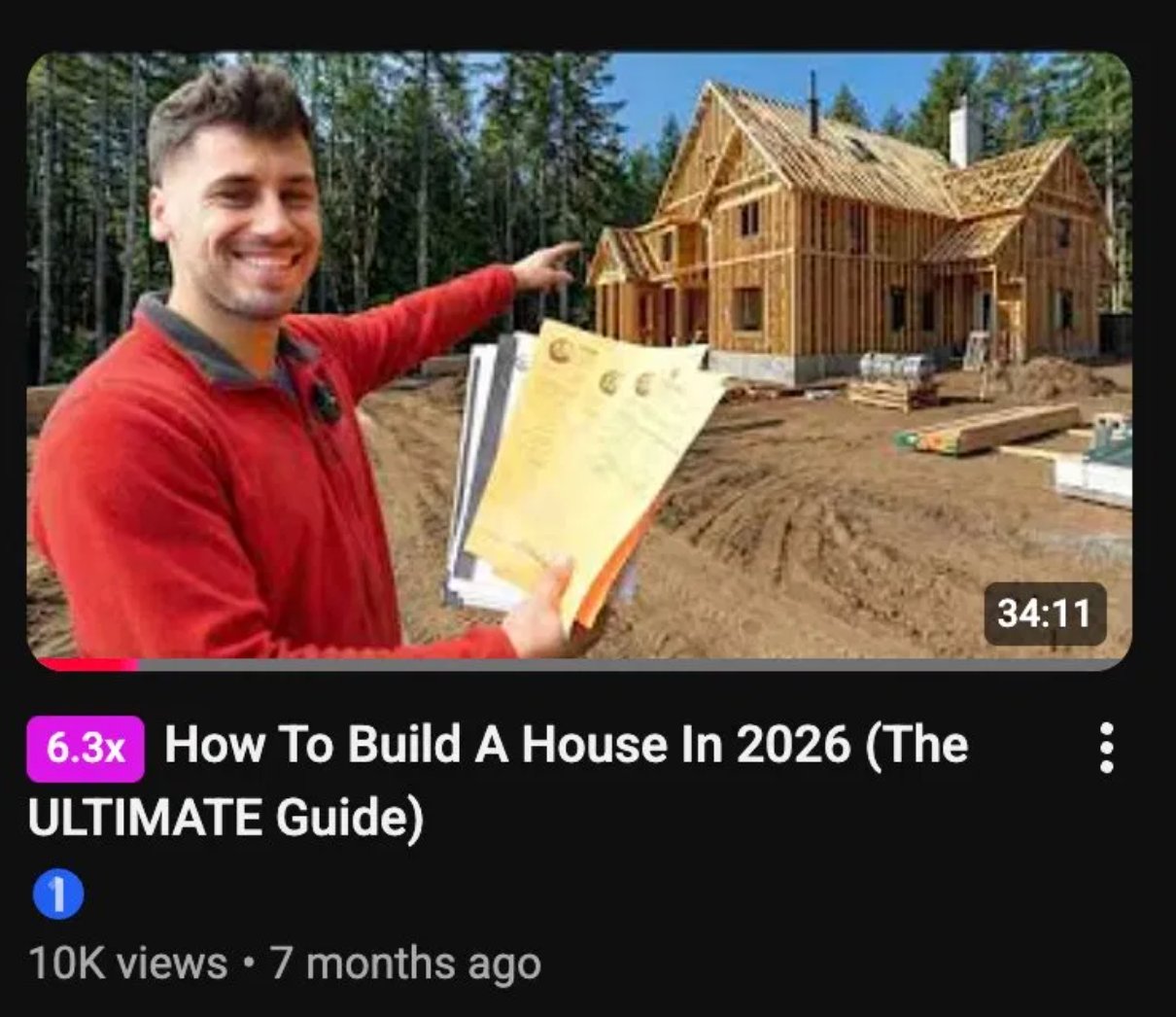
A video like — "REAL Cost to Build a House in 2025"
The AI sweep of @adrielhsu's transcript and full comment section is complete, and the format hypothesis held up cleanly. Full audience and format analysis is in Appendix C — including the single most useful comment in this whole research package: an Eaton fire survivor in Altadena commenting on a Houston builder's video, asking the exact LA-cost question Brass Tacks is built to answer.
Sample #4 — the story people actually wanted to hear.
We've saved this one for last on purpose. Of the four samples, this is the most distinctive pattern in the dataset — the hardest to replicate, the one nobody else in this niche is making, and the one most likely to earn the deepest trust with the affected community. It's the capstone of the deck, not a footnote.
A gardening YouTuber, not a news outlet, not a builder, not an agency. He walked his own land a year after losing his home — and the video performed at 2.4× his channel's normal traffic.
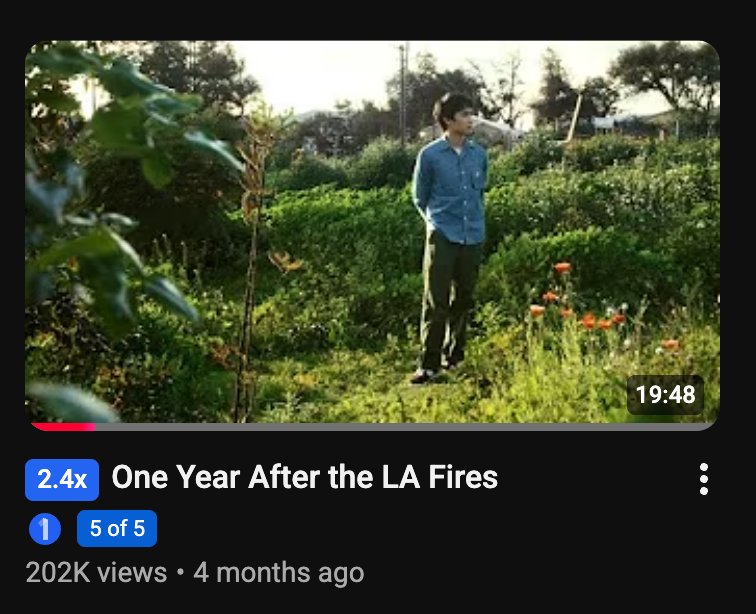
When the AI tools went through the comments, the signal back wasn't only that fire survivors were there. It was the quality of what they were saying. The most-liked comments aren't about the topic. They're about the way he told the story.
And here's the part I keep coming back to. The thing that captivated this audience was not the burned house. We've all seen burned houses. It was watching the land come back to life. The plants regrowing. The fruit trees that survived against the odds. The garden returning. A friend of mine in the affected area has been quietly sharing the same kind of images of her own pomegranate and fruit trees coming back, and the response to those posts is the same kind of thing — people are moved by it.
The takeaway for Brass Tacks is concrete and, I think, the most important format suggestion in this entire document. The format that resonates here is the interview — on the property. We walk a survivor through their own land. They talk about what was lost. They talk about what's still standing, what's coming back, what's changing. We don't try to be the affected person. We can be the warm interviewer who shows up, holds space, and lets them tell their own story while standing in their own backyard.
That is a format this audience — the one we have been trying to figure out how to reach throughout this entire document — is openly hungry for.
Both of you watch the benjiplant video if you have time. The point isn't to copy the format — it's to feel what kind of video this audience is actually hungry for.
Link: youtube.com/watch?v=v6NJmgN8RMY
A video like — "One Year After the LA Fires"
All claims in this document are backed by source materials (screenshots, transcripts, and comment analyses) available in the shared evidence folder. The deeper documentation, including full SEMrush research, detailed competitor breakdowns, and ongoing teaching notes, is available on request.
Our AI tools were used to read the full transcript of the California Insider video and the full comment section beneath it. What follows is the condensed version of both passes — what the video itself was actually doing on camera, and what the audience said back in the thread. Together they form the brief for Pitch 1.
Part 1 — what the video itself was doing.
They were defensive about pricing. Repeated lines like "there's been a lot of confusion" and "when you say we'll rebuild your home for $800 a foot, that could mean a lot of different things." That's the language of someone responding to criticism they've already heard a hundred times.
They were aware of how they were being perceived. The most telling moment in the transcript: "I don't want to call it predatory…" They know the public suspects price gouging. They redirected blame to labor shortages, demand spikes, supply constraints.
They were frustrated with unrealistic expectations. A recurring theme: homeowners think insurance money should cover the rebuild — and the builders know it won't. They kept surfacing hidden costs, soft costs, utility work, code upgrades, inspections, infrastructure. The unspoken message: this is way more complicated than the public realizes.
They were positioned as community insiders, not outside profiteers. The video framed them as locals: "I grew up in the Palisades." "Our family lost homes too." "This town means everything to me." A deliberate choice to inoculate them against the "disaster capitalist" reading.
The dominant emotional posture in the video was defensive, cautious, burdened, pressure-tested, eager to prove legitimacy. Not aggressive. Not opportunistic. Worried about trust.
This video succeeded in part because of the tension between the contractors on camera (defending, explaining, justifying) and the audience in the comments (suspicious, accusatory, looking for villains). That tension is one of the hidden engines of the engagement.
Pitch 1 can't replicate that posture — Brass Tacks isn't the defendant. We're the explainer. But the lesson holds: this audience wants honesty about cost, complexity, and what insurance actually covers. The trust the contractors earned in this video, they earned by being specific about numbers. That's the template.
Part 2 — what the comments said back.
The five questions this audience kept asking, over and over
- Who is going to insure these homes? Can anyone get insurance after this. Is rebuilding even financially viable.
- How much does rebuilding really cost? Open debate in the thread between $600/sq ft and $1,400/sq ft. Real homeowners and real builders arguing real numbers.
- How long will rebuilding actually take? Permits, labor shortages, code upgrades, utility hookups.
- Will another fire just destroy it all again? Rebuilding into fire-prone zones without serious prevention.
- Where did the money go? Donations, taxes, government spending. A pointed question, asked often.
What the comment section responded to most
- Insider-level specificity. Water line upgrades. Edison hookup costs. Fire sprinkler mandates. Hillside foundations. The more technical the detail, the more engagement.
- Real homeowner stories. One Palisades homeowner laid out her insurance payout, her rebuild quote, the gap between the two, and the emotional math. Most-liked comment in the thread.
- Hyperlocal naming. Altadena. Palisades. LADWP. The FAIR Plan. The audience trusts content that names the actual entities.
- "Reality check" framing. Posts that shattered optimism — exposed hidden costs, called out bureaucratic complexity — pulled the most engagement.
The overall tone of the comment section
- Extremely high intensity. This isn't passive viewing. Anger, grief, frustration, distrust.
- Heavy distrust of institutions across the board — insurers, state government, utilities, regulators, media.
- Several commenters self-identifying as builders, developers, or insurance-aware homeowners — creating debates, corrections, and long-form discussions. This topic attracts an informed audience.
Part 3 — the comments, in their own words.
On the gap between insurance and the actual rebuild quote
"I lost my home in the Palisades fire. It was a 2,500-square-foot house on a medium-sloped hillside. My insurance policy covers $750 per square foot, totaling approximately $1.875 million. This is an amount I realize is more generous than what many others received. Still, the road ahead is far from easy. Now, my contractor (a trusted professional I've worked with for years) has quoted $1,200 per square foot, or $3 million total. … The core problem is the enormous gap (often $1 million or more) between insurance payouts and today's inflated rebuild costs."
"As someone actively building in the Palisades and a resident of over two decades — these guys are grossly over-exaggerating the cost per foot to rebuild. I know numerous contractors building for others in the $600–$800 a foot range."
"I can build for much less per sq.ft. Actual cost, $250–$450 sq.ft. The rest is contractor profit."
On the hidden technical costs nobody's naming yet
"I am a very experienced builder in LA for the record, having built many homes since 2015. RIGHT NOW, the homeowners are in phase 1 of the project (planning, foundation, framing, roughs and windows). Great, they have the money for this particular portion. WAIT till they get to the finishes, the electrical hookup — I guarantee LADWP is not gonna eat the cost of putting all the power underground. It is already costing people between $40–60k just for Edison to put the box in for you to pull your wires to. Wait till homeowners get to running new water lines and sewer lines. ALL of these homes are going to need FIRE SPRINKLERS, which you cannot use a 5/8" or 3/4" water line for. … The dark days are coming. They always do."
On insurance
"Who is going to insure these houses?"
"The insurance companies dropped everyone before the fire and people had to go on the California Fair Plan. California wake up!"
"A couple of years ago my homeowner's insurance company stopped renewing any policies. Nothing but the FAIR plan was available. I had to get the FAIR plan, plus a difference-in-condition policy, plus a supplemental policy since the total value covered by FAIR is limited. My insurance costs are now up to $50K/year (not a typo). This is beyond ridiculous and will force people from their homes."
On whether rebuilding even makes sense
"What disturbs me is all this effort to rebuild, while understandable, the fire experts have repeatedly said another fire will happen in the same area. I see no signs that the Governor nor city officials will be prepared to handle another catastrophe."
"People in Altadena don't have the money to rebuild. A lot of those homes in Altadena were inherited."
On where the money went
"What happened to the taxes the city received for the last 50 years?"
"What happened to all the money that was donated?"
And underneath all of it — the emotional baseline
"It feels like the 'anti-American dream.' During this fire, I've been abandoned by the institutions that should have protected us. Now my family and I must navigate this journey largely alone."
"I lost everything in the Palisades fire. Nothing is being done to help us!"
A community asking specific, real, painful questions, rewarding content that respects the specificity. The strongest video Brass Tacks could make here is one that takes one of those five questions and walks it through — with named numbers, named permits, named code requirements — and doesn't try to soft-sell at the end.
That's the brief for Pitch 1.
Our AI tools ran the NBC LA modular-home video and its full comment section the same way they ran Sample #1. The audience profile that came back was just as concentrated with fire survivors — but the posture was different. Where Sample #1's audience was in venting mode, this one was in evaluation mode. Buyer questions, not blame.
Part 1 — what the video itself was doing.
It told one specific story. One Palisades fire survivor. One lot. One modular builder (Cover, based in Gardena). One finished home assembled in days. The specificity is the format — not "modular housing in California," but this person, this house, this timeline.
It walked the path visually. Factory floor → production line → the founder → the finished home on the actual lot. The viewer can follow the path from raw material to handed-over keys. There is nothing left to imagine.
It refused the political frame. No villain. No "who's to blame for the rebuild taking so long." No accountability fight. The fire is the setting, not the subject. That refusal is what cleared space for the audience to do something other than rage.
The company was visible but not the headline. Cover is in frame and named, but the video is about the homeowner's path, not the vendor's pitch. That restraint is exactly what made it readable as journalism instead of advertising — and is a big part of why the comments trusted it.
The Sample #1 video earned trust through tension — defending contractors against a suspicious audience. This video earned trust through restraint. It showed one real path and let the viewer evaluate it. Pitch 2 should inherit that restraint. The brand is in the frame but never the protagonist. The protagonist is the homeowner and the path they took.
Part 2 — what the comments said back.
The questions this audience kept asking
- "How do I sign up?" Asked in many forms. The most direct buyer-intent signal in the thread — people ready to take the next step and asking what it is.
- "Would this work in Altadena?" The audience was extrapolating from the Palisades example to their own neighborhood. Not spectator interest — planning behavior.
- "How fire-resistant is it actually?" Not does the marketing say it's fire-resistant. How much. With skepticism about glass, slats, and wood trim on a "fire-resistant" house.
- "What did it cost? What's the timeline? How fast were permits approved?" The pragmatic trio, asked over and over in different forms.
- "Will this scale — or is it just a rich-person solution?" The recurring skepticism. Fair concern, raised by exactly the people we want.
What the comment section responded to most
- Concrete walk-throughs of a real path. Factory floor, production line, finished home. The audience rewarded the specificity, and asked for more episodes like it.
- Named local geography. Gardena. Palisades. Altadena. Same pattern as Sample #1 — hyperlocal naming earned trust.
- Earthquake and fire performance, asked technically. "How does it perform in an earthquake?" "Wouldn't the glass sliders break?" The audience pressure-tested the premise.
- Practical complaints the reporting didn't answer. The most-liked frustration in the thread was that the segment didn't say what it cost, how long it took, or who to contact. The audience wanted more, not less.
The overall tone of the comment section
- Markedly less political fighting than Sample #1. Less doom, less system-blame, more agency.
- Still skeptical — cost skepticism, scalability skepticism, aesthetic skepticism ("looks like a prison," "an entire neighborhood would look ugly"). Not naive optimism.
- Reads like active rebuild research: displaced homeowners evaluating an option against their own situation, asking the questions they'd ask a vendor.
Part 3 — the comments, in their own words.
On wanting in — the buyer-intent signal
"How to sign up for these types of homes? I lost my home in the Palisades fire and my loved ones are going to rebuild. So hopefully we can get something like this for our next home."
"Awesome! And it's nearby in Gardena! These modular homes are great. I would love my house rebuilt that way and the courtyard and garden in the middle."
"That factory model could work very well in Altadena and a lot of places in Los Angeles."
On cost, timeline, and permitting — the questions the reporting didn't answer
"Great concept, but BAD REPORTING. How much did it cost? How much to assemble? How long did it take? Did the city help, hinder, or do nothing? Contact info for the modular company (or similar providers)?"
"How did she get her permit and approvals so quick?; what was the cost/sf?"
"I contacted Cover last week to build a home. They wanted 30% more than the competition and claimed they wouldn't be able to START till Summer of 2027. No thank you."
On fire and earthquake performance — pressure-testing the premise
"Please; More on this, tell me you have a part 2, 3, 4, 5, 6. How fire resistant is this home compared to stick built?"
"How would it survive a bad fire? Wouldn't the glass sliders break and allow the heat, smoke and flames to destroy the inside?"
"I love the glass, but how does it perform in an earthquake? How do they rate the seismic resilience for the entire structure?"
"I haven't learned much on how it is made, asides of the fact that it is pre-fabricated. I understand the structure is steel but the panels? The house is covered of wood outside and large windows, I don't expect this house be fire proof. It might provide less fuel to the fire but it won't take a big fire."
On scale and affordability — the skepticism we have to answer
"This home was more than likely multi millions. This in-factory concept is not new. Never going to work at scale, sorry to burst your bubble. This is basically custom builder that few people can afford and is tied to CA only. Pass."
"Yeah but the price for just a box is ridiculous — just go to the website."
"All these homes should be modular homes that are going back to Altadena or Palisades, or any fire area. Way more fire resistant and efficient, then custom built or site built homes."
And underneath all of it — the appetite for more like this
"ABSOLUTELY EXCELLENT REPORT — NBCLA WE NEED MORE LIKE THIS. Let's have a Series on Modular Construction! The Build Quality is so obvious, the Fire/Earthquake resistant design… this is the Future not the Past."
This audience is in solution-evaluation mode. They want to see a real path through a real rebuild, with a real person at the center — and they want the practical answers the NBC LA segment didn't deliver: cost, timeline, permitting, performance under fire and earthquake, who to call. The strongest Pitch 2 video is the one that walks one specific Brass Tacks project from start to finish — named homeowner, named timeline, named decisions, named obstacles, named numbers — with the company visible but never the protagonist.
That's the brief for Pitch 2.
The AI sweep of @adrielhsu's "REAL Cost to Build a House in 2025" and its full comment section returned the cleanest validation of the bread-and-butter format we could have hoped for. He isn't a builder. He's a real-estate and personal-finance YouTuber who happened to be developing five homes in Houston, decided to film the cost breakdown, and posted it. The video pulled 36.7× his channel baseline — and the comment section it pulled tells us exactly which moves drove the response, and which audience showed up.
Part 1 — what the video itself was doing.
Real numbers from his actual project. Not "foundation costs vary." The line is "I paid $83,200 for all five homes." That specificity is the single biggest differentiator from every other "cost to build" video on YouTube. It reads as proof, not opinion.
Constant cost anchoring. Almost every section gives three numbers: the national range, the regional (Texas) range, and his exact cost. The repetition is the technique. Each section reinforces that he knows what he's talking about.
Hyper-practical, step-by-step structure. Land → soft costs → foundation → framing → systems → finishes → final numbers → tips. The video follows the actual order a real build happens in. Viewers can locate themselves in the process.
"Hidden costs" treated as a featured section, not a footnote. The soft-costs walk-through (survey, replat, geotechnical report, architectural plans, structural engineering, impact fees, permit fees) is where the comments lit up the most. Most cost videos skip these. Naming them is what made viewers feel like they were getting access to something usually hidden.
The "why" alongside the "what" and "when." He explains why plumbing goes before HVAC. He explains what "dried-in" means. He explains framed area vs. living area. The educational layer is what makes the video feel actionable instead of theoretical.
Transparency about mistakes and savings. He doesn't just list costs — he tells viewers where he saved, where he overpaid, what he'd do differently. The honesty is the trust mechanism.
One thing he didn't do — and the comments punished him for it. He never stated the final total cost per home. The single most-repeated comment in the thread, by a wide margin, is some version of "so how much did it all cost?" A simple fix — state the total up front — and the video would have been even stronger.
The format works because of specificity, structure, transparency, and the willingness to name hidden costs out loud. Brass Tacks has every one of those ingredients available — and one @adrielhsu doesn't: James is actually a contractor, in LA, with current 2026 numbers. The video he can make is a stronger version of the one that already pulled 36.7× baseline. The "state the total up front" fix is also free — we just do what he didn't.
Part 2 — what the comments said back.
What the comments praised most
- Detailed cost transparency. The #1 most-praised element by a clear margin. Repeated phrases: "the BEST video I've come across," "exactly the information I was looking for," "hands down best breakdown I've seen."
- Simplicity and clarity. Construction is normally overwhelming. The step-by-step structure cut through.
- The feeling of insider knowledge. Multiple commenters said variations of "this should be paid content," "you did the world a service," and "I suddenly feel confident again." The video gave people access to information they'd assumed was behind a paywall or a contractor's desk.
- Authenticity. He's actively building. He shows mistakes. He names trade-offs. The audience reads that as trustworthy.
The single most-repeated question
By a wide margin, the recurring comment was: "What was the final total cost per house?" Variations included "so how much did it all cost?", "what's the grand total?", "you never said the final number," and the bluntest version: "Watched that entire video only to not have you say what the final cost per house was……….bruh."
That's the single most actionable lesson from this appendix. State the total up front. Don't make people wait for it. Don't bury it.
Other recurring questions
- Financing. Construction loans, down payments, owner-builder financing, interest carry. Repeatedly requested as a follow-up video.
- Contractor and architect contacts. "Who do you use? Where do I find subs? Can you share a contractor list?" Brass Tacks has this asset built-in.
- Regional comparisons. "Would this apply in my state?" California viewers especially showed up with their own numbers.
- Did he act as his own GC? Repeated curiosity about whether owner-building saves real money or creates hidden costs.
Patterns in the comment section
- Aspirational energy. A lot of "this is my dream" and "I want to build now." The video reduces fear. That emotional layer is part of why it overperformed.
- Regional debate — especially around LA. California viewers consistently showed up to say the Texas numbers don't apply at all to them, and named their own much higher per-square-foot figures. This is the audience Brass Tacks is built for — and they're already gathering in this kind of comment section, asking the LA question and getting Texas answers.
- Builder social proof. Other contractors and developers showed up in the comments validating his numbers with their own ("I'm at $104/sqft in Georgia," "I'm at $85/sqft in Houston"). The format invites peer validation, which strengthens the video further.
- High-intent audience. Almost nobody in the comments was a casual viewer. They were planning builds, doing renovations, evaluating contractors, or running their own developments. Exactly the audience Brass Tacks wants reading their channel.
- Heavy demand for tools and templates. Spreadsheets, PDFs, contractor lists, checklists. The audience is openly asking for downloadable assets — a clear lead-magnet opportunity sitting underneath the video.
Part 3 — the comments, in their own words.
On the transparency and clarity — what the format earned
"This is excellent information, contractual cost based on amounts, thank you so much for giving us this information. People don't really understand how hard is to have access to this kind of information."
"Though I'm in Georgia, this is the BEST video I've come across that gives detailed advice and information. I suddenly feel confident again."
"You have done the world a huge service making this video. Thanks for sharing this incredible info. I wish we were friends; I bet we could save each other hundreds of thousands with a few conversations over the next few years."
"Hands down best break down I've seen!"
On the missing final number — the one lesson we don't repeat
"Watched that entire video only to not have you say what the final cost per house was…….bruh."
"So how much did it all cost?"
"Wish you gave FINAL totals for all 5 homes AND each individual home all said and done at the END of the video."
On regional cost difference — and the LA audience showing up unprompted
"I live in Los Angeles and I always find it crazy how different the costs are to build here vs almost everywhere else in the country! I'm in the middle of building a custom home in Altadena, CA (after we lost our home in the Eaton fire) and I am looking more at $600–$800 a square foot, and that's for Owner Builder. But very high end finishes…"
That comment is the single most important data point in this entire research package. An Eaton fire survivor, in the middle of rebuilding in Altadena, found a Houston builder's cost video and showed up in the comments asking the LA question. The audience is already searching. They're already commenting. They're just not getting LA-specific answers, because nobody is making LA-specific videos.
"I bought a lot in California for 250k, split it, but it took 6 years to get approved and cost me 130k in entitlements and holding costs… then the permits per unit were $75k, and the construction cost was 375 a foot… that was the cheapest we could pull off as owner builder. Contractors quoted 450."
"I live in Austin and it's about $700 a sq ft to build."
"Wow, construction in South Florida is very different. Cheap construction is at $200 a square foot. Not including land. Basic finishes. Below-slab plumbing alone is $10,000–$14,000."
On peer validation — other builders proving the format works
"This was actually a very good breakdown. Thank you. I just got done with two new constructions here in Georgia and I'm at $104/sqft to include the land."
"Great video. I'm at $85/sqft right now in Houston. Working on two new builds in the EADO area."
On the aspirational pull — why this video reduces fear
"This is my dream — running my own project and taking my kids there to spend time together."
On the demand for tools and templates — the lead-magnet signal
"Great vid, do you have a PDF list of all the cost items you covered?"
"How can I get a breakdown spreadsheet of all these numbers?"
"You should post a written cost breakdown to help."
The audience is already there, the format already works, and the source video has handed us a tested playbook plus one obvious correction (state the total cost up front). The strongest Pitch 3 video is the LA version of this format, made by someone who's actually a contractor in LA — with current 2026 numbers, named line items from a real Brass Tacks project, the hidden-cost section treated as featured material, the total stated in the first 60 seconds, and the regional-comparison hook (Texas is X, LA is Y, here's why) used to pull viewers from outside the immediate area as well.
And underneath the video itself, the lead-magnet signal is unmissable: a cost-breakdown PDF or spreadsheet, offered in the description, would collect emails from the exact audience Brass Tacks wants to be in front of. That's the brief for Pitch 3.
The AI sweep of the benjiplant "One Year After the LA Fires" video and its full comment section returned something we didn't see in either of the other two Samples. The signal wasn't only who was there. It was the quality of what they were saying — and just as importantly, the shape of the video that pulled that quality of response out of them.
Part 1 — what the video itself was doing.
Deep specificity, not generic tragedy. The script refuses big-picture language. Instead of "I lost my home in the fires," it's the favorite rock, the bamboo path, the goats near the school, the neighbor planting wildflowers, the repotting table, the paint samples taped to the wall, calling the dog "Leo" instead of "Theo." The loss becomes tangible because the life that was lost was rendered tangible first.
"Before vs. after" framing, without melodrama. The opening anchors in ordinary, happy detail: Christmas hosting, New Year gatherings, gardening dreams, contentment. The fire is dropped against that calm baseline. The contrast carries the weight — the script doesn't have to.
Calm, restrained narration. He doesn't perform grief. He doesn't direct the viewer toward a feeling. The understatement is the technique — emotion lands harder when it isn't being announced.
Nature as the through-line. The returning plants — native species coming back through the burn, the fruit trees that survived, weeds becoming the first green — do double duty: they're literal regrowth on the lot, and they're the metaphor for community survival. He never spells the metaphor out. He lets the footage say it.
Layered storytelling. The same 25 minutes simultaneously work as a personal diary, a memorial to a house, a nature-documentary segment, a portrait of Altadena's community, light climate commentary, and a one-year rebuild update. No layer dominates. No layer is sacrificed.
Honesty about what he doesn't know yet. No silver-lining ending. No "and here's the lesson." No CTA. The video ends in hopeful uncertainty — will he rebuild, will he come back, is the neighborhood going to be Altadena anymore — and that unresolved ending is part of why the comment section behaves the way it does.
The lesson isn't "make beautiful videos." The lesson is that restraint — specificity over generality, calm over performance, unresolved over neatly-bowed — is what this audience is missing everywhere else, and what they're starving for. Brass Tacks doesn't need a film school. We need the discipline to not over-tell.
Part 2 — what the comments said back.
What the comments were actually doing
- Thanking him. Most-liked comments in the entire thread are some variation of "thank you for this," "I needed this," "this is the only thing that's made me feel seen all year."
- Sharing their own stories. Affected residents using the comment box to write about their own losses, their own gardens, their own returning fruit trees, their own decisions to rebuild or leave.
- Witnessing each other. Comment-on-comment threads where survivors responded to other survivors. The video isn't holding the audience — the audience is holding itself. That's a behavior almost no YouTube video earns.
- Reflecting philosophically. The plant-regrowth footage triggered an unusual amount of writing about ecological succession, native species, resilience as a concept — the comments become almost spiritual.
What the audience kept coming back to
- Not the burned house. They've seen burned houses. They weren't there for destruction footage.
- The land coming back to life. The single most-discussed element across the whole thread. Plants regrowing. The fruit trees that survived. The first green. This was the captivating part — and it's the same thing affected residents are quietly sharing with each other off-platform.
- Altadena itself. The "mayor" Gordon, the goats, the horse walker, the vintage car guy. People saying out loud that they're afraid of losing what makes Altadena Altadena.
- The way he told the story. Slow. Present. Not directing the emotion. Just walking.
The recurring question (there really is only one)
This audience didn't ask a lot of buyer questions. The one question that recurred — in different phrasings, from different commenters — was a version of: "Will you rebuild? Will you come back?" They were asking on behalf of themselves. They want to know what someone like them decides.
One more pattern worth naming
Preservation anxiety. Repeated across the thread: fear of developers, fear of bland rebuilding, fear that the architectural and cultural character of Altadena gets erased in the rebuild. This is the same emotional vein the Pitch 2 video taps ("This Would Ruin Altadena") — and it's a vein Brass Tacks is uniquely credible to speak to.
Part 3 — the playbook, for Brass Tacks's own stories.
1. Start with intimate "before," not statistics.
Not "the fire destroyed X homes." Start with the ordinary: a routine, a favorite spot in the yard, a Tuesday morning, a meal someone used to make. The contrast does the emotional work. We bring the viewer into the life first; the loss lands second.
2. Make the place a character.
Altadena's identity carried this video as much as the fire did. Names of neighbors. Names of businesses. Specific corners. Specific streets. The local detail is the texture our audience is starving for — and it's the texture no national rebuild story has. "Love letter to a place" is a real strategic frame, not a sentimental one.
3. Film the regrowth, not the rubble.
If we shoot one of these stories on a lot, the burned slab is not the shot. The shot is what's coming back. Plants returning. Surviving trees. Wildlife. Seasonal change. Before-and-after on the same plant. The regrowth footage is the single most powerful element this video had — and it's the cheapest, easiest thing to capture in the field.
4. Pace it slowly. Don't fill the silence.
The temptation will be to over-edit and over-music. Resist it. Slow pacing and restraint are what made the audience trust this video. Let the homeowner pause. Let the camera linger. The silence isn't dead air — it's where the viewer leans in.
5. Don't direct the feeling.
No swelling music telling the viewer to cry. No voiceover labeling the emotion. No on-screen text underlining the meaning. The audience is fully capable of feeling it themselves — and they resent being told to.
6. Let the personal expand outward, but only at the end.
This video earned the right to talk about climate, rebuilding policy, insurance, and Altadena's future only because it spent 80% of its runtime on one specific person and one specific lot. The wider lens is the last move, not the first. Brass Tacks's structural advantage in this space (we know the policy, the costs, the permitting) should sit at the end of these stories, not the front.
7. Include the community around the story.
The local restaurant segment in the original video grounded the personal grief in a real, ongoing recovery. For Brass Tacks's stories, that means: bring in the neighbor, the local business owner, the contractor on the next lot, the nursery owner replanting. The single homeowner is the spine; the community around them is the body.
8. End in hope, but not resolution.
The comments responded most strongly to the unresolved ending. "I don't know yet" reads as honest. "And that's how we rebuilt" reads as a brochure. Leave the story open. Let the audience sit with it.
9. Reserve the right to say what we actually believe.
The video carried a light layer of climate and FEMA commentary without losing the audience — because it was earned. Brass Tacks has real opinions about prefab housing, contractor pricing, developer behavior, and what Altadena should look like in five years. The template here says we can voice those — after we've told a real story first.
This audience is hungry to be witnessed. They want to see their experience reflected honestly, without being directed toward a feeling or a takeaway. The strongest Pitch 4 video is the one where we walk a survivor through their own land — let them talk about what they lost, what's still standing, what's coming back — and let the silence do its work.
The interview-on-the-property format is what this audience is openly asking for. And the nine moves above are the playbook for not just Pitch 4, but every time we tell a survivor's story going forward.
This appendix backs the at-a-glance summary in Part One. James pulled 16 keyword trunks from SEMrush; I consolidated near-duplicates, removed obvious junk (RuneScape "OSRS construction," Comcast fiber, Animal Crossing, GTA helmets, hyper-local agency artifacts), and ran every remaining cluster through one test: does this topic solve one of the three problems our ideal client actually has? What survived is 15 homeowner-facing clusters and a small contractor-business-side tail. Volumes below are rough monthly U.S. search demand, combined across variants where relevant.
Section 1 — homeowner-facing clusters.
Cluster 1 — How to find / hire / vet a contractor
The single biggest opportunity in the dataset. High volume, exact buyer intent.
- Find a contractor (general): ~1,100/mo combined. Saturated on YouTube — needs a sharp angle (red flags, scams, what to ask).
- Find a general contractor: ~650/mo. Slightly stronger buyer-intent than just "contractor."
- Find a construction contractor: 390/mo.
- Find a contractor for home renovations: ~590/mo. Renovation-specific, high-value buyer.
- Find a building contractor: ~580/mo. Implies new construction or major work.
- Choose / pick a contractor: ~410/mo. Different framing — these searchers already have candidates.
- Hire a contractor: ~520/mo. Bottom-of-funnel — ready to sign.
- Contractor for small jobs: 70/mo. Probably out of lane if Brass Tacks is doing big projects.
- Contractor for home addition: 40/mo. Pairs with ADU/addition content.
- Contractor near me / local: ~220/mo combined. High commercial value despite lower volume.
- Find a home contractor: 140/mo.
- What is the Blue Book / verify a contractor: 210/mo. Homeowner doing serious due diligence.
Cluster 2 — Big-builder brand questions (DR Horton, KB, Toll Brothers)
Surprise high-volume cluster. A custom LA builder can position directly against these names.
- Is DR Horton a good builder: ~830/mo combined. One of the strongest single opportunities in the dataset.
- Is KB Homes a good builder: ~340/mo combined.
- Is Toll Brothers a good builder: ~290/mo combined. Luxury tier — closest overlap with LA custom-build market.
- Largest homebuilder in the US: 50/mo. Easy explainer.
- DR Horton red tag event: 70/mo. Niche but pure buyer intent.
Cluster 3 — Finding / choosing a home builder (generic)
- Find a home builder: ~180/mo combined.
- Find the builder of a home (existing homeowner researching their own house): ~1,150/mo combined. Could pivot to "should I trust the builder of my home?"
- Who builds houses near me: ~130/mo. Local intent — Brass Tacks should rank for this.
- Choose a home builder / GC: ~320/mo combined.
Cluster 4 — ADU fundamentals (what is an ADU?)
Massive education-stage cluster. CA homeowners still figuring out what an ADU even is.
- "What is an ADU" and variants: ~13,000+/mo combined. The single highest-volume topic in the entire dataset. Likely saturated on YouTube; one definitive explainer is still worth making.
- "What does ADU stand for": ~6,000+/mo combined. 30-second explainer — easy win.
- ADU vs junior ADU vs accessory unit: ~360/mo combined.
- ADU size / detached / backyard: ~240/mo combined.
Cluster 5 — ADU permits, property rules, build logistics
Buyer-stage. They've decided ADUs exist; now they want to know if they CAN build one.
- Can I build an ADU on my property: ~540/mo combined. Pure ADU lead-gen.
- How to build an ADU: ~460/mo combined.
- Does an ADU count as square footage: 40/mo. Affects appraisal and taxes.
- Does an ADU need a kitchen: 70/mo.
- How to get an ADU permit: ~90/mo combined.
Cluster 6 — California ADU grant / funding
- Is the California ADU grant still available: ~210/mo combined. Time-sensitive but evergreen-able ("CA ADU Grant 2026 Update").
- ADU in California (general): ~120/mo combined.
Cluster 7 — Architect costs & hiring
Strong homeowner pain point. People want a number before they call.
- How much does an architect cost: ~1,570/mo combined. Definitive pricing explainer — could be the most-clicked video on the channel.
- Architect cost for house plans: ~190/mo combined.
- How much to hire an architect: ~420/mo combined.
- Hire an architect for a custom home: 70/mo. Bottom-of-funnel.
- How to find an architect: ~270/mo combined.
Cluster 8 — AIA & architect credentials
- What does AIA stand for / what is AIA: ~1,420/mo combined.
- What is an AIA contract / agreement: ~390/mo combined. Pure homeowner-protection content.
- American Institute of Architects: 110/mo.
- What is a residential architect: ~220/mo combined.
Cluster 9 — House fire recovery
Unexpectedly rich. Homeowner in crisis — high empathy, high conversion.
- What to do after a house fire: ~1,510/mo combined. One of the highest-conversion topics in the data.
- What to do if your house burns down: ~630/mo combined.
- What happens after a house fire: 140/mo.
- What to throw away after smoke damage: 390/mo. Practical, list-style, easy YouTube hit.
- Who buys fire-damaged homes: 140/mo. Lead-gen for cash buyers, or pivot to "sell or rebuild?"
Cluster 10 — Fire prevention & safety
- How to prevent a house fire: ~1,130/mo combined.
- How to put out / stop a fire: ~1,120/mo combined.
- How to eliminate smoke from house: 140/mo.
- How hot do house fires get: ~4,180/mo combined. Curiosity-driven, not buyer-intent — low priority but easy clicks.
Cluster 11 — Construction project timelines
- How long does new home construction take: small per-variant volume but consolidated cluster.
- Commercial construction timelines: skip unless Brass Tacks does commercial.
- Learning / studying construction: career-seeker intent, not homeowner — skip.
Cluster 12 — Construction contract review
Small, extremely high-intent.
- How to review a construction contract: 110/mo+. This is where the "red flags in a contractor's bid" angle lives.
- How to write a construction contract: 110/mo. Contractor-side — demote.
Cluster 13 — LA-specific renovation queries
Pure local lead-gen. Best for the website / Google ranking, not YouTube directly.
- Best LA remodeling / renovation companies: ~350/mo combined. Voice-search artifacts — real intent is "best remodeler in LA."
- LA general contractor: ~160/mo combined.
Cluster 14 — Home addition vs ADU (decision content)
- Home addition vs ADU: trunk surfaced mostly hyper-local agency-bidding noise. Topic is valuable; build it anyway based on first-principles homeowner intent.
Cluster 15 — Custom home misc.
- How much is a 3-story house: 40/mo.
- Build a custom home in Los Angeles: volume not captured but high-value local title.
- Are people still building new homes in LA: market-state video angle.
- Container homes in LA: YouTube loves container-home content — real upside.
Section 2 — contractor-business-side clusters.
These attract other contractors, not homeowners. Include only if Brass Tacks also serves the trade (consulting, training, software). Otherwise skip.
- Cluster 16 — Finding construction jobs / contracts to bid on: ~1,800/mo combined.
- Cluster 17 — Construction lead generation: ~470/mo combined.
- Cluster 18 — Contractor business / money / hiring: medium-high combined. Fertile if contractor-side education is on the table.
The first 15 videos — recommended batting order
If we were optimizing purely for SEO-derived YouTube targets — high volume + clear homeowner buyer intent + room to put a distinctive angle on the title — this is the order I'd put the first 15 videos in. (Note: this is the SEO-pure list. The four Pitches in Part Three deliberately diverge from it, for the reasons Part Two lays out.)
- Is DR Horton a Good Builder? — brand name = clicks, custom-builder POV.
- How Much Does an Architect Cost? — 590+/mo on the head term, top homeowner pain point.
- What Is an Accessory Dwelling Unit (ADU)? — largest cluster in the data, evergreen.
- What to Do After a House Fire — high empathy, high conversion.
- How to Find a Good Contractor — foundational topic.
- What Does AIA Stand For? — easy explainer, builds authority.
- Can I Build an ADU on My Property? — pre-purchase ADU lead-gen.
- Is the California ADU Grant Still Available? — CA-specific, time-sensitive.
- How to Review a Construction Contract — the "contractor scams" angle lives here.
- What to Throw Away After Smoke Damage — practical, list-style, easy YouTube traffic.
- Is Toll Brothers a Good Builder? — luxury tier, closest to LA custom market.
- How to Find a Contractor for Home Renovations — high-value buyer intent.
- How Much Does It Cost to Hire an Architect? — reframe of #2 with a different YouTube angle.
- How to Hire an Architect for a Custom Home — bottom-of-funnel.
- How Long Does New Home Construction Take? — project-planning content for buyers.
The list above is what the SEO data alone would recommend. The four Pitches in Part Three are deliberately different — because what the YouTube research in Part Two showed is that titles like these, made the obvious way, get buried alongside ARM Builders' 15-view videos. The SEO clusters here are topics worth owning; the Pitches are how to actually earn the audience for them. Both matter. Neither replaces the other.